
Acre's Command Problem
A Classic Lesson in Too Many Chiefs . . .

There’s a moment in the Templar of Tyre’s chronicle, one of those small devastating details that good medieval writers drop without fanfare, where he notes that when the outer wall finally broke and the fighting came into the streets, the various commanders of Acre’s defense were essentially sending runners to each other to find out what was happening. With a hundred thousand Mamluk soldiers pouring in through the breach, they were sending runners. Runners. That single image tells you everything you need to know about why Acre fell, and it has nothing to do with the size of Khalil’s army or the quality of his siege train.
It has to do with the fact that Acre wasn’t really a city at all. By the time the Red Tent appeared on the hill to the east, it was a collection of armed jurisdictions that happened to share a harbor.
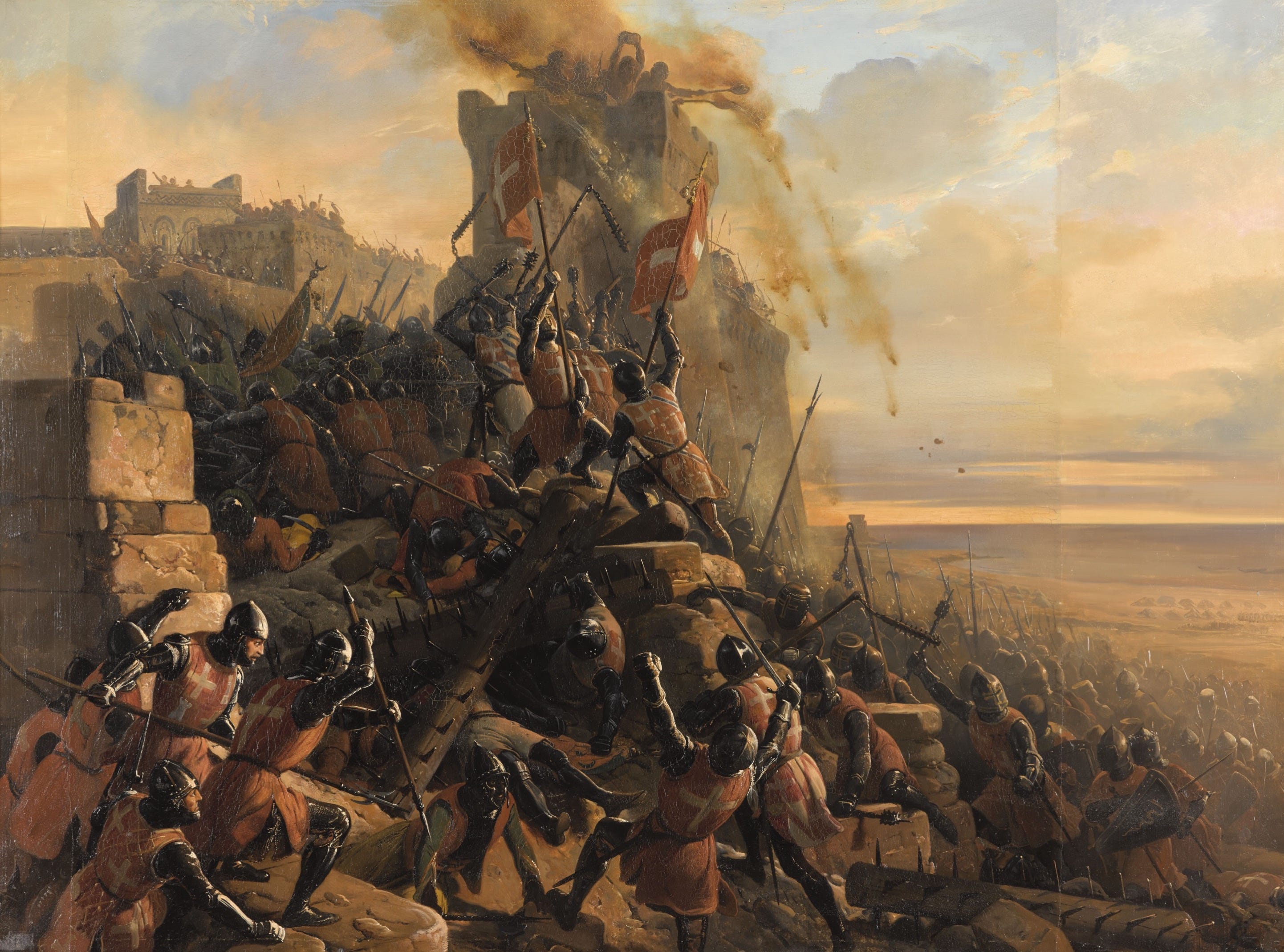
Let me explain what I mean, because the fall of Acre gets simplified in the popular imagination — and, I’ll be honest, sometimes in the historical literature — into a story about overwhelming force meeting inadequate defense. Muslim East versus Christian West. Numbers and siege engines versus walls and valor. And that’s not wrong, exactly, but it misses the deeper pathology, the structural rot that had been eating through the city’s defenses for decades before Khalil ever issued his first order of march. The question isn’t why couldn’t they hold the walls? The question is why, with a garrison of somewhere between 700 and 1,000 knights and a defensive perimeter that was genuinely formidable, did the city’s leadership spend the weeks before the siege arguing about jurisdiction?
Here is what the defenders of Acre were working with when the armies arrived in March of 1291. You had Prince Amalric, King Henry II’s younger brother, serving as regent while Henry convalesced in Cyprus with the characteristic timing of a man who has been asked to hold a burning building and has chosen this moment to take a holiday. Amalric was in an almost impossible position. He was young, eighteen years old; his authority was delegated rather than sovereign, and the city he was trying to govern was not constitutionally arranged to be governed by anyone. He presided over a council that included, at various points, the Grandmaster of the Temple, the Grandmaster of the Hospital, representatives of the Teutonic Knights, the Church, the Venetian and Genoese and Pisan factors, and a constellation of secular lords whose feudal relationships dated to a kingdom that had essentially ceased to exist in any territorial sense one hundred and four years earlier, at the Horns of Hattin. These men did not owe Amalric their obedience. They owed him their courtesy, which in a crisis is worth considerably less.
Then there was Nicholas de Hanapes, Latin Patriarch of Jerusalem and Bishop of Acre. He spoke with the Pope’s authority, wielded the power of Roman gold, excommunication, and the threat of an Inquisition to bring about the Pope’s wishes. On paper, he was the ruler of Acre in this time of tribulation. But steel cares nothing for paper, and the reality was he was sidelined in much the same manner as Jacques de Vitry was a century earlier: baffled by the bullshit of overlapping spheres of authority that prized gold above their own souls, it seems. He did not survive the siege, sadly — though his gold somehow wound up on a Venetian ship . . .
The military orders are where the structural problem becomes truly visible. The Templars and Hospitallers were, in theory, under the aegis of the Patriarch. In practice, in Acre, they were independent powers. The Templar compound occupied the southwestern corner of the city and was, in effect, a fortified enclave within the fortified city — towers, stables, warehouses, and enough armed men to constitute a small army answerable to Guillaume de Beaujeu and, above him, to the Pope, and not, emphatically not, to the regent of a kingdom they had been watching slowly disintegrate since the loss of Jerusalem. The Hospitallers held the northeastern quarter with the same autonomous ferocity. Beaujeu and the Hospitaller Grandmaster, Jean de Villiers, did not hate each other, precisely. Their relationship was more complicated than that, like Papal sons vying for supremacy. They did not conduct joint operations, they did not share intelligence freely, and when the council meetings grew heated, which they did with the regularity of Levantine weather, the two orders positioned themselves on opposite sides of the argument as a matter of reflex.
And then you had the communes. The Venetians had their own quarter, their own courts, their own commercial law, their own militia, and their own siege artillery. The Pisans, too, had their own mangonels — a battery of heavy artillery positioned in the garden of the monastery of St. Romanus that they operated independently, according to their own priorities. The Genoese, whose relationship with the rest of the city was complicated by the reasonable suspicion that they had spent the previous few years trying to maneuver the whole situation to their commercial advantage (and to repay their Venetian adversaries for the loss of their stronghold at Tripoli), had made their own arrangements. They sat this one out.
By and large, these powers were not defecting to the enemy. They were fighting. They were fighting hard and they were fighting well, within their own walls and on their own terms, and that is precisely the problem: the defense of Acre was conducted by a collection of entities each optimizing for its own survival rather than for the survival of the whole.
Compare this to what was happening outside the walls.
Sultan al-Ashraf Khalil, too, was young — close in age to King Henry II — and had only been sultan for four months; already he had executed several potential rivals and ordered the largest single mobilization of Mamluk military force since Ain Jalut. His army had one commander. His siege operations had one chain of command. When he decided that the assault on the Accursed Tower should be prosecuted with additional machines from the northern battery, the machines moved. When he decided that the night sorties from the city were disrupting his engineers’ work and needed to be countered, countermeasures were implemented. His Red Tent was visible from the walls, which was a deliberate piece of theatre, true, but also a piece of communication. There is one man making these decisions. You know where he is. You cannot negotiate with him, because he has nothing to gain from negotiating. You cannot wait him out, because he has more food and more men and more patience than you do, and he knows it, and he wants you to know that he knows it.
The tragedy of Guillaume de Beaujeu is that he understood all of this with a clarity that none of his contemporaries seemed to share. He was the only member of the council who consistently argued for the kind of centralized, unified response that the situation required. His intelligence network, which was extensive and generally excellent, had been telling him for years what was coming. His two attempts to avert the final crisis, the substitution gambit with the condemned criminals and the private embassy to Khalil, were exactly the kind of unconventional, asymmetric thinking you’d expect from a man who understood that he was losing a game of conventional military chess and was looking for a different game to play. He was overruled both times by a council that could not agree on the color of the sky and whose understanding of their strategic situation was, with a few exceptions, catastrophically inadequate.
He died in the fighting on the eighteenth of May. The tradition says his last words to the men around him were something like: Sirs, I cannot help you more. I am dying. See the wound! Whether or not those precise words are authentic, the sentiment feels true. He had spent years trying to help and had been prevented from helping by the architecture of the institution he served, and when the architecture finally collapsed, all he had left was the wall and the sword and the fact that he stayed.
King Henry II arrived on May 4th with his relief fleet, fourteen days into the siege, and I want to be careful here not to pile onto Henry in the way that some accounts do, because the arithmetic of his situation was brutal regardless of when he arrived. He brought enough men to strengthen the garrison but not enough to break the siege, and by the time he arrived the outer defenses had already been under serious assault for two weeks and the momentum was entirely on the Mamluk side. What his arrival did, or should have done, was consolidate the command structure — if anyone could speak with sovereign authority in Acre, it was the King — but by May 4th the various factions had settled into their defensive arrangements with the stubborn territorial logic of men who have stopped thinking about the whole and are thinking only about their piece of it, and Henry presiding over councils with that quality of formal authority that medieval kingship could generate even when the king had no real power to compel was not going to change that.
Acre did not so much fall as it came apart at the seams. It ruptured, broke into its constituent parts — Templar, Hospitaller, Venetian, Pisan, Papal, Royal1 — and was consumed with single-minded purpose. The Mamluk army that came through the breach was unified, purposeful, and responsive to a single will. It moved through the city like water through something that was already cracked.
There is something almost unbearably poignant about it. The finest defensive fortification remaining in the Latin East, manned by soldiers of genuine skill and courage, but headless because the institutional arrangements that governed the city’s defense had never been designed for unified action. They had been designed for the coexistence of sovereign entities in a shared space, which is an entirely different thing, and when the moment came to be one city instead of many jurisdictions, there was no mechanism for the transformation. They had built walls but not a command. They had built towers but not a chain of authority. They had built, stone by stone over two centuries, the most expensive and elaborate monument to political dysfunction in the history of the Crusader states, and in the spring of 1291 it was measured, found wanting, and dismantled by a twenty-something-year-old sultan with one tent and one will and all the time he needed.
Acre fell because of a vast and sustained assault by war machines, yes. It fell because of the numbers and the engineering and the relentless professional competence of the Mamluk siege corps. But it also fell because when the walls began to crack, nobody was entirely in charge of all of them.
The crowned heads of Europe also sent their representatives — especially Jean de Grailly of France and Othon de Grandson of England, representing King Edward Long-shanks (who was too busy appearing in the movie Braveheart to bother with this business of Crusades). Both men survived.
"But it also fell because when the walls began to crack, nobody was entirely in charge of all of them." I can't help but think the best that could have been asked of any such unified command, by the point of the siege, would be to spare the defeat the heavy tinge of tragic farce. Really interesting piece, though. Thanks!
Excellent articles like this serve to shore up my woeful lack of exposure to these pivotal moments in Western Civilization. My fifth grade history class taught that there were eight? nine? Crusades, and even back in the early 80's, there was some creeping language that these were not the proper thing for civilized people to have endeavored.
Now I am elbow-deep in Grokopedia looking at the Crusades. Thanks for writing this.