
The Last City
Acre on the Eve of Ruin, Spring 1291

Much of the detail for the following article comes from a wonderful monograph by the late Professor David Jacoby called “Aspects of Everyday Life in Frankish Acre”; any errors are my own.
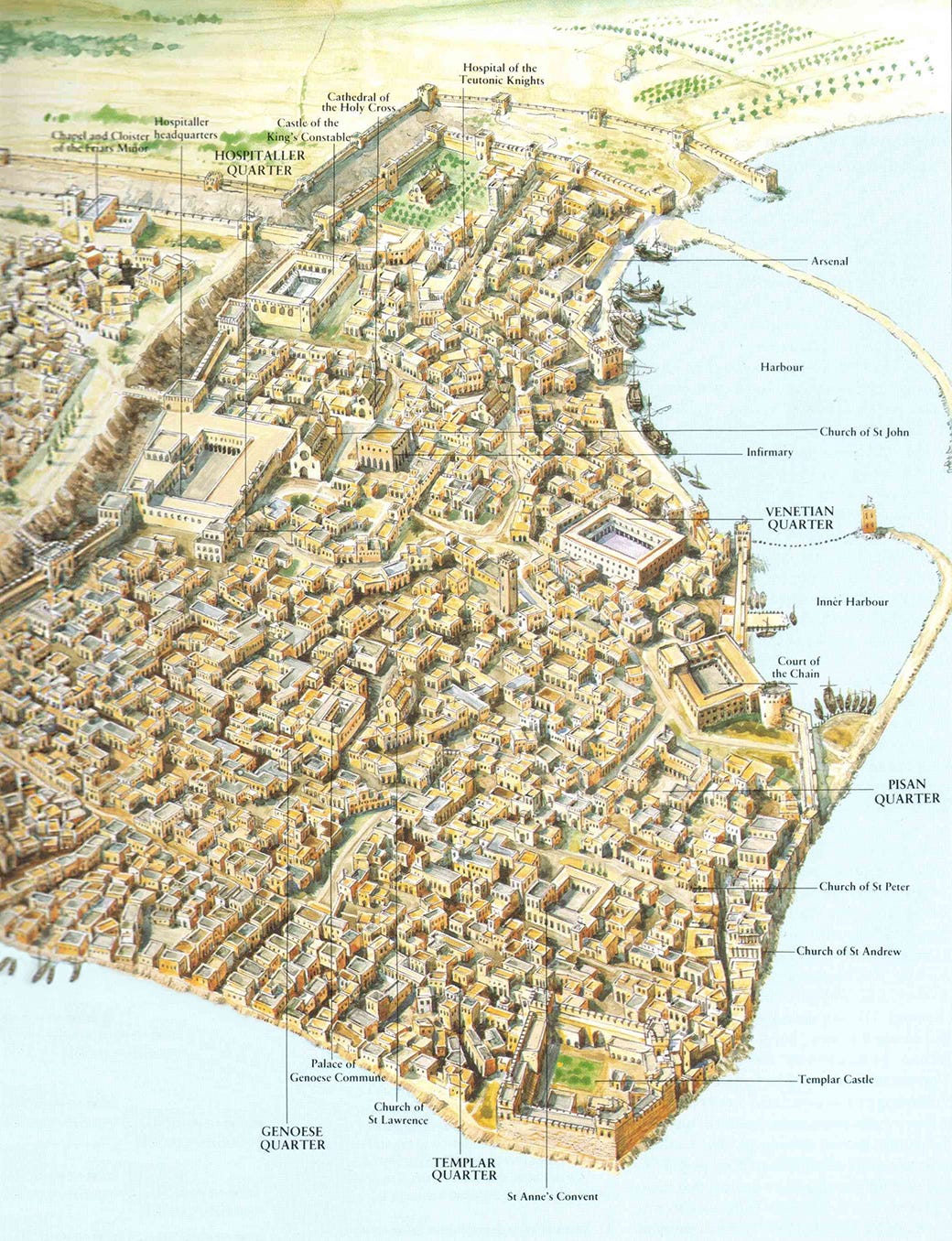
On the eve of the 1291 siege, the city of Acre was a thriving, yet deeply strained, medieval emporium that served as the final political and ecclesiastical heart of the Latin Kingdom. Following the fall of Tripoli in 1289, Acre remained the last significant Crusader state in the Levant. The city was a dense, rhomboid-shaped urban center divided into two primary sections: the ancient Old City to the south and the expanding suburb of Montmusard to the north.
The city was encased within a sophisticated double wall system on its landward front, a massive defensive project completed in the early 13th century. Within these walls, Acre was a patchwork of autonomous, fortified quarters. Powerful maritime nations like Venice and Pisa, along with military orders such as the Templars and Hospitallers, maintained self-contained urban entities with their own thick walls, gates, and impressive towers.
The Old City: This was the most densely populated area, characterized by a maze of narrow, tortuous streets leading to bustling marketplaces. The Quarter of the Chain near the harbor was particularly crowded.
Montmusard: In contrast, this northern suburb retained a semi-rural character, with patches of built-up areas alternating with open spaces, gardens, and orchards. It housed the Hospitallers’ auberge, a magnificent palace and convent.
Acre’s harbor was the lifeline of the city, protected by a southern breakwater and the Tower of the Flies. An iron chain — a trophy taken from Constantinople — controlled access to the inner harbor. Despite its economic importance, the harbor was notoriously polluted; the local Frankish population nicknamed it Lordemer (the filthy sea) due to the refuse and sewage that drained into its stagnant waters, creating a pervasive foul smell.
The name Lordemer was a literal description of the harbor’s ecological state. It served as the terminal point for an overall sewage system that served the entire Old City, carrying waste directly into its waters. Furthermore, the royal slaughterhouse and fishmarket were situated nearby, and their leavings were routinely dumped into the harbor. Because the water circulation was insufficient to clear this accumulated refuse, the harbor became a stagnant basin of filth and excrement.
The environmental conditions often became unbearable. Lordemer was notorious for its evil smells, which intensified during the hot months of May through October. The pollution was so severe that in 1261, the Venetian authorities were forced to seal off the main windows of the Church of St. Demetrius, located near the shore, to prevent the wind from blowing filth onto the altar. Foreigners and pilgrims often fell ill due to the “corrupted” air, and the Greek pilgrim John Phokas noted that the harbor’s conditions led to frequent deaths among visitors.
Despite the stench, the harbor was a site of intense, year-round activity. Because large vessels could not accommodate the shallow harbor, they anchored in the bay, where their cargo and passengers were ferried to the quay by a fleet of smaller barks. This created a constant movement of people, including porters, merchants, sailors, and middlemen.
The logistical heart of the harbor was the Court of the Chain, a massive complex that functioned as a custom-house, warehouse, and market. Every item entering or leaving by sea had to be registered and taxed there by Christian officials who often kept their accounts in Arabic. Near these customs stations, money changers and bankers waited to meet arriving travelers, while guides offered tours and rented out horses and donkeys.
The streets behind the Court of the Chain were no less a sensory assault: shouting merchants, pilgrims, and soldiers; markets overflowing with local grain, fruit, and soda ashes, alongside luxury goods like Acre-produced soap, glass beakers, and portable icons.
The population was a vibrant, often volatile, mix of cultures. Clean-shaven Frankish knights and Latin settlers lived alongside bearded Syrian (Oriental Christian) peasants, Jewish communities, and visiting Muslim merchants. While daily economic intercourse was common, social stratification was strict, and visual markers like beards or specific headgear defined one’s status.
The atmosphere grew increasingly desperate in late 1290. Tension exploded when a rabble of newly arrived crusaders rampaged through the markets, killing bearded local Christians they mistook for Muslims, as well as Saracen merchants. This massacre prompted Sultan Khalil to declare his truce with Acre null and void.
War was coming.
Fascinating history