
On Mary Renault
Influence, Divergence, and the Art of Historical Fiction

While I let “The Gift” simmer a bit, I want to talk about the other primary influence on my work: Mary Renault. Born Eileen Mary Challans in 1905 (yes, she was a year older than REH), she wrote contemporary fiction at first, but then became famous the world over for her depictions of Classical Greece. In 1956, she published The Last of the Wine, her first foray into historical fiction (second, actually . . . during her university years at Oxford — 1924-1928 — a tutor suggested she write a Medieval novel; she did, but burned the manuscript because it lacked authenticity. That tutor was JRR Tolkien). She followed that with The King Must Die (1958), The Bull from the Sea (1962), The Mask of Apollo (1966), Fire from Heaven (1969), The Persian Boy (1972), The Praise Singer (1978), and Funeral Games (1981). Renault passed away from cancer on December 13, 1983.
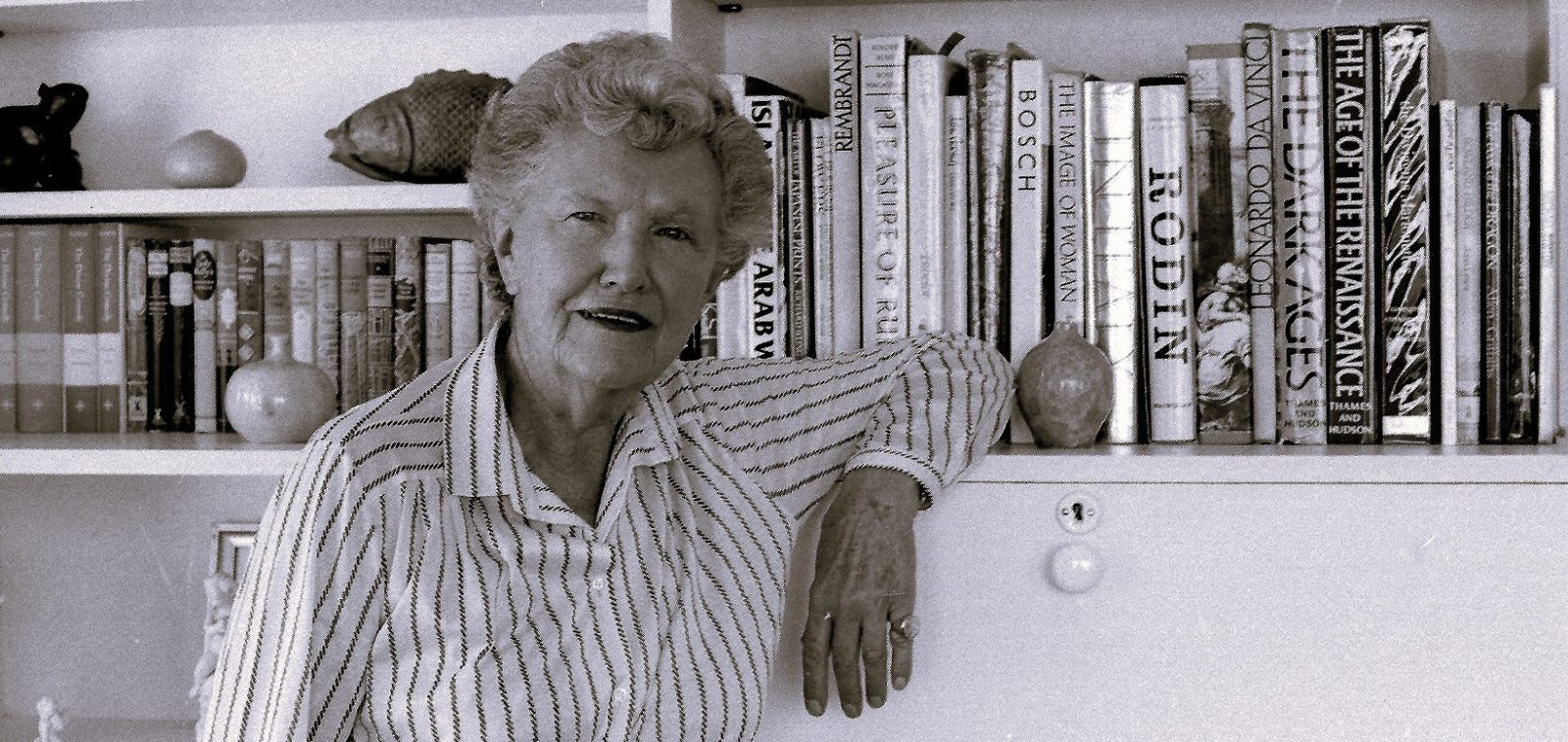
If you’ve ever read her work, then read mine, you can see her fingerprints all over certain pieces — namely, Memnon and “Xenia in the Court of the Winds”; her influence is less evident in the other works of mine, especially the Grimnir Saga. But, she’s in there. She’s one of the foundational blocks of my writing, along with REH, Steven Pressfield, and Karl Edward Wagner.
Let me be blunt, here: for all that I try to lift inspiration from her work, Mary Renault writes on a wholly different level from me; she is a sorceress who can conjure ancient Hellas from the dust of Antiquity and make it live in our imaginations. I know the incantations, but my conjurations are but mere echoes.
Her novels are fundamentally humanistic explorations — they use the past as a mirror to examine universal questions about love, identity, and the nature of leadership. When she depicts Theseus or Alexander, she’s interested in their interior lives, their psychological complexity, the philosophical frameworks that shaped their understanding of the world. Her prose is elegant, measured, literary in the best sense. She wanted to make the ancient Greeks comprehensible to modern readers, to show that despite the gulf of centuries, human hearts beat to the same rhythms.
My novels are picaresque adventures that drip blood. I spend less time trying to make my historical characters relatable; I’d rather make them vivid, to conjure them with all their alien strangeness intact. When I write about Barca or Phanes in Men of Bronze, I’m channeling Howard’s headlong narrative drive, his sense that every page should crackle with energy. My historical fiction has one boot in scholarship and the other in sword-and-sorcery. I want the sweat and the blood and the stink of ancient battlefields. I want action that rises off the page.
If I had to sum up the essential difference: Renault wrote to illuminate the human condition through the lens of antiquity. I write to make the ancient world come alive as a place of savage beauty and harsh realities, where heroes are as flawed as they are formidable. She refined the historical novel into a vehicle for philosophical inquiry. I’m trying to keep the pulp tradition alive while honoring historical authenticity.
Memnon and the Alexander Problem
It was Renault’s influence more than anything else that gave me the courage to write a book like Memnon (2006, Medallion Press). And it was her lionization of Alexander of Macedon that drove me to consider a narrative that looked at him from the enemy’s point of view.
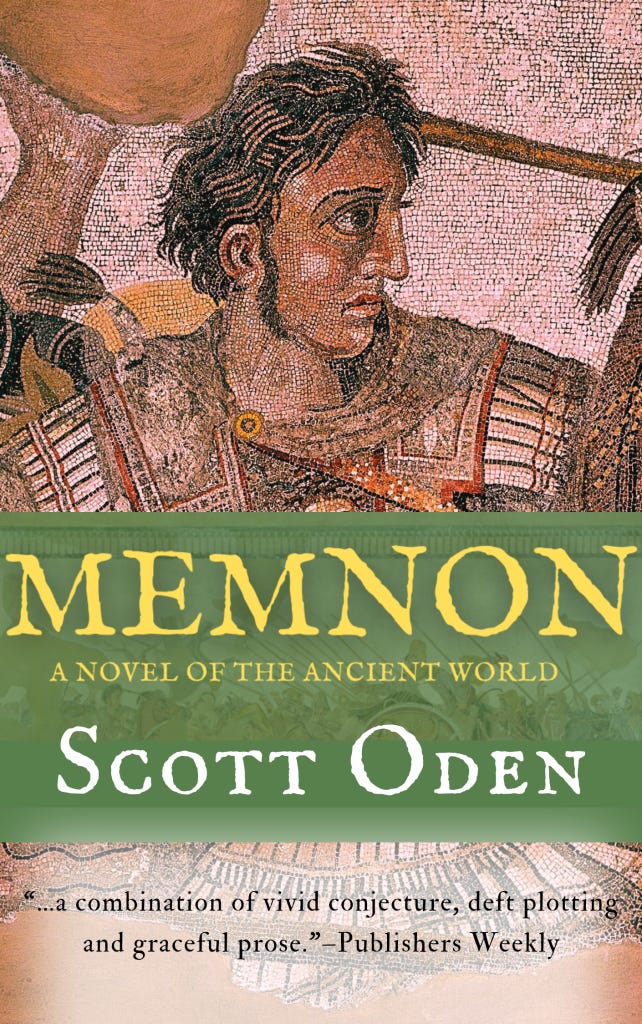
Renault’s Alexander trilogy (Fire from Heaven, The Persian Boy, Funeral Games) covers the life of Alexander the Great, both from his own perspective and from those closest to him. We see Alexander as a brilliant, complex, charismatic figure — beautiful, flawed, driven by divine ambition. Renault makes us understand him, even love him, even when he’s at his most terrible. Her Alexander is the protagonist of his own epic.
Memnon deliberately inverts that perspective. Memnon of Rhodes was Alexander’s most capable opponent — the one man who might have stopped the Macedonian juggernaut if the Persian King had listened to his counsel. By telling the story of Alexander’s invasion from Memnon’s point of view, I was trying to do what Renault herself excelled at: showing that history depends on where you’re standing when you witness it. Alexander wasn’t a hero to everyone. To Memnon and the Persians, he was a barbarian invader, a destroyer of civilizations, a creature of savage ambition wrapped in Homeric pretensions.
This is exactly the kind of shift in perspective that Renault excelled at. Think about The Persian Boy, where she tells Alexander’s later campaigns through the eyes of Bagoas, the Persian eunuch who became his lover. Renault understood that the greatest stories emerge when you give voice to those on the margins, those who see the “great men” of history from unexpected angles. Memnon, like Bagoas, is a character history barely remembers, a footnote in Alexander’s legend. But both Renault and I recognized that these forgotten figures carried truths the conquerors never acknowledged; they carried the humanity of the legend.
Outsiders and the Question of Identity
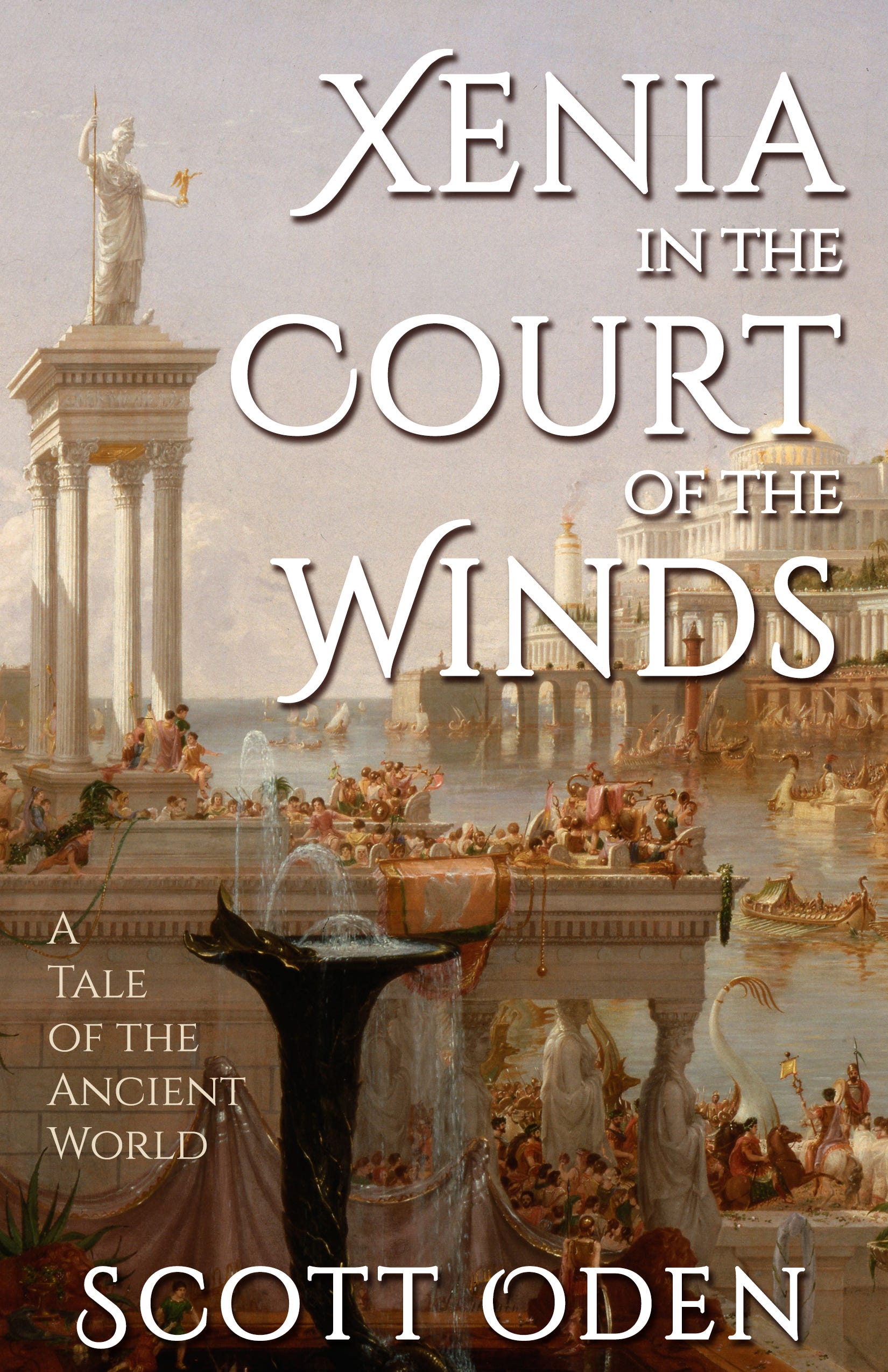
“Xenia in the Court of the Winds” is my retelling of the Polyphemus story from The Odyssey, but told from the Cyclops’s perspective. In my version, Polyphemus isn’t a mindless monster but a giant, one-eyed foreigner living on the fringes of Greek society, scavenging shipwrecks and violating the sacred laws of hospitality because he himself has been excluded from those laws. When Odysseus blinds and robs him, Polyphemus seeks justice at the Court of the Winds, asking a fundamental question: can an outsider, someone who flaunts convention and is labeled “monstrous” by society, still find justice?
Renault spent her entire career writing about outsiders, people who existed on the margins of acceptable society, who loved differently, who challenged the norms of their time. Her work was revolutionary in its sympathetic portrayal of same-sex relationships in the ancient world, depicting them not as aberrations but as integral parts of that world’s social fabric. She gave voice to characters like Bagoas, who was both slave and lover, neither fully accepted nor entirely rejected.
In “Xenia,” I’m working through similar territory: the question of who gets to be fully human in a society’s eyes, who gets to claim the protection of sacred customs like xenia (guest-friendship), and whether someone branded as a monster can ever escape that label. Polyphemus, like many of Renault’s characters, is trying to navigate a world that has already decided what he is before he’s had a chance to prove who he might be.
Renault’s willingness to sympathize with outsiders, to humanize characters whom the dominant culture labeled as aberrant or monstrous, gave me permission to do the same with Polyphemus. She showed me that you could take a canonical villain and ask: what if the monster has a point? What if justice looks different from his perspective?
Yet for all our differences in style and approach, there are threads of connection woven through the craft itself. We both share a devotion to getting the details right, to understanding the worlds we’re depicting.
Renault traveled to Greece and Crete, walked the ground where her characters walked, immersed herself in the geography and archaeology of the ancient world. She understood that historical fiction isn’t just about costumes and battles; it’s about recreating a mentality, a way of seeing the world that’s fundamentally alien to modern readers. Her Greeks aren’t modern people in togas, they’re genuinely other, shaped by honor codes and religious beliefs that feel strange to us.
I come at this from a similar place of obsessive research, though my methodology is different. I’ve spent years poring over primary sources — Diodorus, Arrian, Plutarch — filling in the gaps of Memnon’s story with informed speculation. I’ve studied the military tactics, the geography, the political intrigues of the Persian Empire and the Greek city-states. When I write about the Granicus River or the siege of Halicarnassus, I want readers to smell the blood and dust, to hear the clash of iron and bronze.
This commitment to authenticity is something Renault and I absolutely share. We both believe the past deserves to be treated with respect, to be brought to life as something more than a backdrop for modern concerns. Our characters may speak to contemporary readers, but they must first and foremost be citizens of their own time. Historical fiction requires more than just scenery. It demands immersion in a different way of thinking, a different relationship to honor, duty, and the divine.
But perhaps the deepest connection between my work and Renault’s is our shared sense of tragedy.
Memnon is, at its core, a tragedy. We know from the first page that Memnon will die before he can fulfill his promise, that his great plans will come to nothing, that Alexander will win and the Persian Empire will fall. The entire novel is shadowed by this foreknowledge, by the reader’s awareness that history has already rendered its verdict. Memnon fights with courage and brilliance, but he’s fighting against fate itself.
Renault understood this better than almost any historical novelist. Her Alexander trilogy is infused with a profound sense of mortality and loss. Even at the height of his power, Alexander is haunted by the knowledge that all glory is fleeting, that even conquerors die, that empires crumble. Funeral Games shows us the savage aftermath of Alexander’s death, the way his generals tore his empire apart in their scramble for power. There’s a melancholy to Renault’s work, a recognition that all human achievement is transient.
We’re both writing in the shadow of the Greek tragedians, trying to capture that sense of mortals striving against impossible odds, making choices that feel heroic even as they lead inevitably toward destruction. Our characters aren’t just historical figures; they’re tragic heroes in the classical sense, undone by fate, by circumstance, by their own natures. Tragedy isn’t just about defeat—it’s about the dignity of the struggle, the honor in fighting for what you believe even when you know you’ll lose.
Mary Renault and I are walking different paths through the ancient world. Her prose is elegant and measured where mine is kinetic and visceral. She contemplates where I charge forward. But we’re both trying to resurrect voices that history has allowed to fall silent. We’re both committed to showing that the ancient world was populated by real people with complex emotions and difficult choices. We’re both fascinated by outsiders, by those who stood on the margins and saw things differently. And we both believe the past deserves to be more than museum exhibits and dusty textbooks. It was a living, breathing, sweating reality for the people who inhabited it.
The past is vast enough for many kinds of storytelling. There’s room for both the philosopher and the pulpster, for contemplation and for bloodshed, for the measured examination of human psychology and for the visceral immediacy of battle. We’re all just trying, in our different ways, to keep the dead from dying twice.
I stand in awe of what Mary Renault accomplished. Whether you approach the ancient world through her measured prose or my more kinetic style, the goal is the same: to make readers feel the weight of history, to hear voices that have been silent for millennia.
Some debts should be acknowledged. This is mine.
Have you read Adrian Goldsworthy's book about Alexander (and Philip)? He's a military historian specialised in antiquity so his interpretations of battles are often different from historians with no deep knowledge of ancient tactics (for instance the Granicus, often presented as a mad dash from Alexander seems actually to have been a very clever move).
Mr Goldsworthy argues that Memnon's strategy (scorched earth) was just not a realistic one both from a political and military perspectives.
I was not aware of Mary Renault. I'm certainly gonna look into her work. Amy suggestions on where to start?