
Funeral Games
Mary Renault's Final Novel Just Hits Wrong

I try to read for an hour or so every night. The past few nights, I’ve been re-reading Funeral Games by Mary Renault. This was her last novel, published two years before her death in 1983, and I’m sorry to say you can feel it. The book lacks the vitality that made her earlier work so compelling, the kind of energy that animated The King Must Die or even The Persian Boy. Where those novels had flesh on their bones, Funeral Games reads like an exhausted chronicle of political maneuvering, a game of thrones played by too many interchangeable generals — none of whom I could bring myself to really care about.
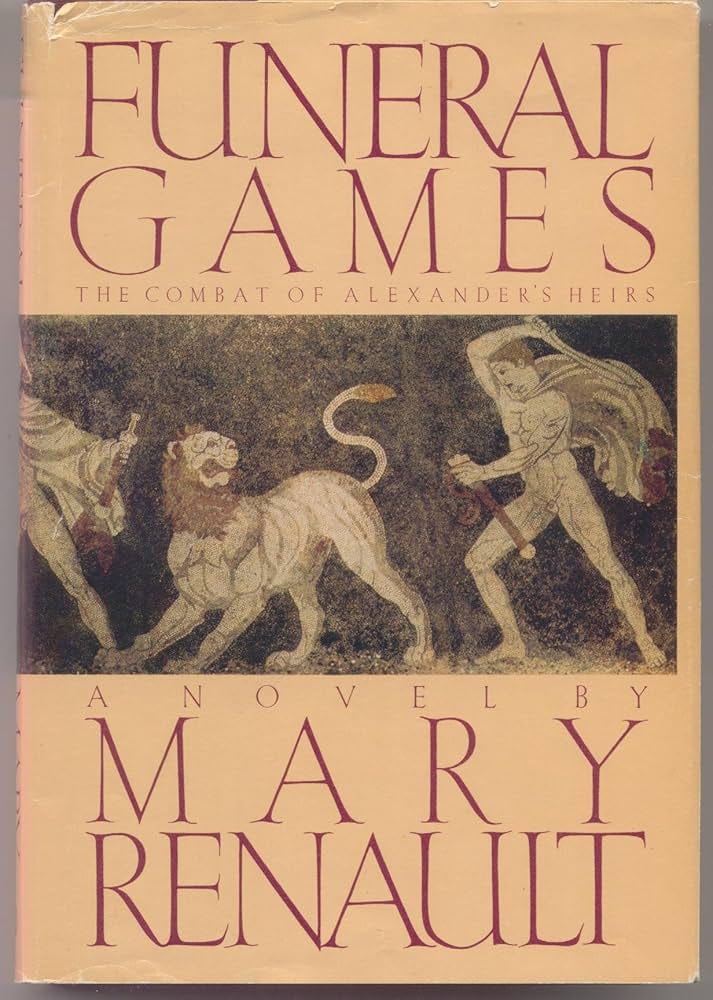
The sheer number of characters means few are well-developed, and what might have been a gripping tragedy instead becomes a roster of names attached to betrayals and murders. Key figures like Kleopatra vanish without explanation, and the empire’s ultimate division goes unexplored. It’s all scaffolding without a building. Renault’s prose, once so precise and musical, here feels tired. The mechanics are sound, the historical research impeccable as always, but the soul is missing. When a writer of Renault’s caliber starts treating history as mere chronicle rather than lived experience, you know something’s wrong. This one felt like duty, not love, and it made me inexplicably sad to reach the end.
As an antidote, last night I started reading the first volume of W. Ruth Kozak’s impressive Shadow of the Lion. I first met Ruth years upon years ago, on a message board about Alexander the Great called pothos.org. I read a good bit of Shadow of the Lion in manuscript; I blurbed it, and even wrote the introduction to the second volume. But I’ve never read it as a physical book.
The two-volume epic covers the same ground as Funeral Games, but with vast amounts of room to breathe. Ruth manages the same large cast skillfully, giving memorable portrayals of figures like Ptolemy, founder of the Egyptian dynasty that bears his name, and young Iskander, Alexander’s son by Roxane. The books are idols dedicated to the gods of detailed research and vivid depictions, and yet they’re still eminently readable. Like Mary Renault, Ruth walked a good bit of the ground Alexander once trod, having lived in Greece for many years.
Shadow of the Lion was published in 2014 and 2016, but it’s physically out-of-print; there is a single-volume ebook edition available from the author via Amazon (here’s the link). If you’re looking for a novel of the Diadochi, Alexander’s successors, written with energy and attention to individual characters rather than just the broad sweep of political machinations, this might be worth trying.
What are you reading, these days? Drop a comment and let us know . . .
Interesting….. I remember being very sorry for Euridike
I'll have to check these out