
A Quarter Turn
On Guy Gavriel Kay and the Space Between History and Fantasy

Since Greg Mele’s comment, the other day, I’ve been giving some thought to the works of Guy Gavriel Kay, which is dangerous because once you start thinking about Kay you end up in this weird territory where you’re not sure what genre you’re even discussing anymore. Historical fiction? Fantasy? Some third thing that doesn’t have a proper name yet?
Kay calls it “history with a quarter turn to the fantastic,” borrowing a phrase from a reviewer that he liked enough to steal. And that phrase — that quarter turn — gets at something essential about what makes his work so hard to categorize and so worth reading.
Let me back up. Kay started as a high fantasist. The Fionavar Tapestry, his debut trilogy from the late 1980s, is straight-up Tolkien-esque epic fantasy — which makes sense, since Kay spent time in his early twenties helping Christopher Tolkien edit The Silmarillion. In The Fionavar Tapestry, five people from Toronto get pulled into a secondary world, there’s a Dark Lord, ancient prophecies, the works. It’s good if you’re into that sort of thing, which I am on occasion, but it’s also exactly what it looks like: high fantasy in the tradition Kay learned at Tolkien’s knee.
Then in 1990, Kay published Tigana.
Tigana is set in a peninsula that looks and feels like Renaissance Italy but isn’t quite Italy. The geography’s different, the names are changed, and there’s magic — but not much. Just enough to give Kay room to maneuver, to compress timelines, to heighten the emotional stakes without turning the whole thing into a wizard duel. The core of the book is about a conquered province whose very name has been erased through sorcery, so that only people born there can remember it. Everyone else hears something else, sees something else written on maps.
It’s a metaphor, of course. Obviously. For cultural genocide, for the way conquering powers try to strip identity from the people they subjugate. But by making it literal, by using magic to externalize the psychological process, Kay gives the metaphor teeth. You can’t dismiss it as exaggeration. In the world of Tigana, memory erasure is real, and the characters have to deal with that reality rather than just the historical echo of it.
That’s the quarter turn. Kay takes a historical period, in this case, the Italian Renaissance, and rotates it just slightly into the fantastical. The bones are the same. The human drama is the same. The political intrigues, the cultural tensions, the way power works . . . all straight from history. But the fantasy element gives him permission to universalize, to make the story about more than just that specific time and place.
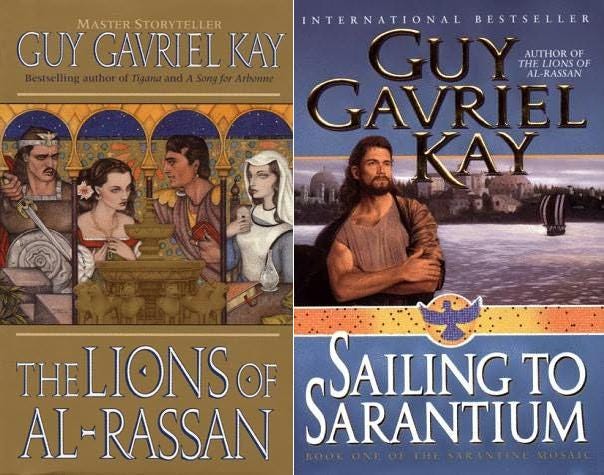
The Lions of Al-Rassan does the same thing with medieval Spain and the Reconquista. Kay’s Al-Rassan is clearly the Iberian peninsula, his Asharites are Muslims, his Jaddites are Christians, his Kindath are Jews. But they’re not exactly those groups, because Kay’s changed the religions, tweaked the geography, compressed four centuries of conflict into a single generation.
The Asharites worship the stars. The Jaddites worship the sun. The Kindath worship two moons. These aren’t Islam, Christianity, and Judaism; they’re reflections, echoes, versions that rhyme with the real thing without being identical to it.
And that quarter turn gives Kay freedom. He can show us Rodrigo Belmonte, who’s obviously inspired by El Cid, fighting alongside Ammar ibn Khairan, a poet-warrior-assassin who has no single real-world analogue but carries pieces of several historical figures. He can show us Jehane, the Kindath physician, caught between worlds, loving both men, watching everything she cares about get ground up in the machinery of holy war.
If this were straight historical fiction, we’d be anchored to what actually happened. El Cid fought for both Christian and Muslim kings, sure, but we know how his story ends. We know the Reconquista took centuries and the Christians won. Kay’s quarter turn lets him compress that timeline, heighten the tragedy, make the fall of Al-Rassan feel immediate and personal rather than an inevitable historical process we’re watching from a distance.
But it’s not just compression. The fantasy element — minimal as it is in most Kay novels — creates distance. By making it clear from the start that this isn’t exactly our history, Kay gives readers permission to engage with the themes without getting tangled in the politics of whose version of medieval Spain is the “correct” one. You’re not reading about the Reconquista. You’re reading about what happens when religious zealotry overwhelms tolerance, when political necessity destroys friendship, when the world you’ve built starts collapsing and you can’t stop it.
Kay’s doing something else, also. He’s using the past as a lens to examine human nature, to ask questions about loyalty and identity and what we owe to each other when the world’s falling apart. His characters aren’t alien. They’re us, or they could be, dropped into circumstances that test them in ways our comfortable modern lives usually don’t.
That’s why Kay’s fantasy elements are usually so minimal. In The Lions of Al-Rassan, there’s barely any magic at all; just enough to signal that this is a secondary world, not a history textbook. A physician can occasionally sense when death is near. There are old legends about spirits and enchantments, but they’re just legends, the kind of folklore that exists in any pre-modern society. The real drama is entirely human: political machinations, personal betrayals, the slow-motion catastrophe of watching tolerance give way to fundamentalism.
The Sarantine Mosaic — Kay’s take on Justinian’s Byzantium — has a bit more magic, but it’s still subtle. There are hints of the supernatural, moments where characters glimpse something beyond the material world, but Kay never lets it overwhelm the fundamentally historical feel of the narrative. Mostly, you’re reading about court intrigue, theological disputes, chariot racing, and one man’s attempt to create art that will outlast the empire crumbling around him.
In Under Heaven, based on Tang Dynasty China, Kay gives his protagonist the ability to see ghosts. But even that’s restrained. The ghosts are there, yes, but they’re not the point. The point is the political chaos, the way a single man’s journey across a vast empire becomes entangled with forces beyond his control, the slow collapse of a golden age.
Kay’s fantasy is functional. It’s there to create space, to allow him to mash up different historical elements without violating the reader’s sense of what’s plausible, to externalize psychological states in ways straight realism can’t quite manage. But it never takes over the story. You’re always reading about people, not wizards.
I keep coming back to that phrase: quarter turn. Not a half turn, not a full rotation into pure fantasy. Just a quarter. Just enough to break free from the constraints of documented history without abandoning history’s weight, its complexity, its refusal to provide easy answers.
This is a hard trick to pull off. Go too far into fantasy and you lose the historical grounding that gives the story its punch. Don’t go far enough and you’re just writing alternate history, which is fine but tends to get bogged down in “what if X happened instead of Y”.
Kay walks that line better than almost anyone. His worlds feel real in the way historical fiction feels real; you believe in the politics, the cultural tensions, the way power flows through institutions. But they also feel liberated in the way fantasy feels liberated, unmoored from the specific constraints of documented events, free to heighten and compress and rearrange.
Take A Song for Arbonne, his riff on medieval Provence and the Albigensian Crusade. Arbonne is a matriarchal culture where women hold power and courtly love is woven into the social fabric. That’s not quite medieval Provence, where women did have more power than in many parts of Europe but weren’t running kingdoms. Kay’s exaggerated it, clarified it, made it more distinct so the contrast with the brutal northern kingdoms feels sharper.
And that exaggeration serves the themes. Arbonne is about what happens when a culture built on art and love and relative gender equality gets crushed by religious fundamentalism and martial masculinity. If Kay had stuck to strict history, he’d have to deal with all the messy contradictions of actual medieval Provence; the ways in which the real Cathars weren’t nearly as enlightened as their later admirers claimed, the economic factors that drove the crusade, all the boring realpolitik that makes historical events make sense but drains them of moral clarity.
The quarter turn lets Kay simplify without being simplistic. Arbonne is better than the northern kingdoms — more cultured, more tolerant, more humane. And the invasion is a tragedy, not a complex political event with valid arguments on both sides. Kay’s not interested in both-sidesing the Albigensian Crusade. He’s interested in what it feels like to watch your civilization die, to know you’re defending something worth saving and lose anyway.
Critics sometimes hit Kay for being too sentimental, too romantic, too invested in beauty and tragedy and doomed nobility. And yeah, there’s some of that. His prose can get lyrical in ways that remind me of the good Professor, JRRT — all those landscape descriptions and characters having Deep Thoughts about mortality and art.
But I think the criticism misses something. Kay’s romanticism isn’t naive. He knows his characters are going to lose. Lions ends with Al-Rassan conquered, Tigana ends with a pyrrhic victory that costs nearly everyone everything, Arbonne ends with the culture Kay’s spent the whole book making you love getting crushed. There’s no illusion that the good guys win or that standing up for what’s right guarantees anything except suffering.
What Kay’s interested in, and this is where his work diverges most sharply from typical fantasy, is how people bear that suffering, how they maintain their humanity in the face of forces too large to fight. His characters make art, fall in love, try to do small kindnesses in the middle of catastrophe. They’re not heroes who save the world. They’re people trying to save each other, or failing to, or choosing loyalty over survival even when they know it’s pointless.
That’s tragedy in the classical sense. Not “bad things happen” but “people of quality are destroyed by circumstances beyond their control, and we watch them go down fighting anyway.” Kay’s characters aren’t flawed in the Aristotelian sense, they’re not undone by hamartia, some tragic flaw. They’re undone by history, by being in the wrong place at the wrong time, by loving the wrong people or the right people in ways the world won’t accommodate.
So where does this leave Kay in the landscape of fantasy and historical fiction? He’s carved out a space that didn’t really exist before him . . . or if it did, no one was working it as consistently or as well. You can find echoes of what he does in other writers. Mary Renault played with historical compression and heightened drama in her Greek novels. Rosemary Sutcliff mixed historical research with mythic storytelling. But Kay’s fusion of the two modes feels unique, more deliberately balanced.
He’s not trying to recreate the past with documentary accuracy. He’s trying to use the past to illuminate something about the human condition — about how we love, how we lose, how we keep going when everything we’ve built is falling apart. The fantasy element isn’t escapism. It’s a tool for focusing the lens, for making the themes hit harder by removing some of the historical clutter that gets in the way.
Greg Mele’s comment, the other day, was about how I can use Kay as a template for my own work. Scratch my two itches, so to speak. In retrospect, this is pretty much what Conn Iggulden did with his Caesar trilogy. They weren’t remarkably historical. Indeed, one could argue they were as much fantasy as HAJ’s Hannibal clone, Hanuvar. By rights, I could leverage my interest in Conan’s rise to the throne with Baibars’s rise and create a slightly skewed version of history where a barbarian slave-soldier wins his freedom, becomes involved in a triumvirate with an ambitious woman and her future husband, and finally seizes the crown for his own. That would be a great story, I think. Bloody and thunderous, with a touch of romance and a bit of tragedy. And, by making it quasi-historical I could guide the historical aspects down the paths they should have taken, rather than how things played out in reality.
I won’t lie. There’s a seductive reasoning behind that. Kind of like Grimnir, but without the monsters and perhaps with very subtle magic. Keep my hyperfocus in check by learning the pure historical aspects . . . but give free rein to my creative side by taking what I need and discarding what doesn’t fit my story.
It’s entirely possible Greg is right: the Guy Gavriel Kay path might be the right path for me. History with a quarter turn of the Weird. The best of both worlds, provided I can balance the history with subtle magic (I’m looking at you, The Lion of Cairo). At any rate, it is something to consider . . .
"A quarter turn" is a good way to describe what Kay and a few others do by straddling between history and subtle touches of fantasy that nonetheless free the reins of storytelling. It's also a testament to his ability that he's been able to rise above the inevitable critics who, in what I can only imagine is a mix of pedantry and anxiety to display their trivia knowledge, insist on pointing out perceived historical "inaccuracies" in what are ultimately works of fantastic fiction. Expecting relative historical accuracy or plausibility is understandable in historical fiction or even genres such as the Western, regardless of the fact that most of the latter stories take place in a rather mythical West. In genres such as fantasy or sword & sorcery where a story might echo real historical episodes or settings, expecting accuracy strikes me as fanboyish infantilism that often unfairly criticizes solid fiction.
I'm glad it created food for thought. What he does isn't easy, but others could certainly work in that vein--and it allows the big themes of history and the less fleshed out figures, times, places to have a voice they might not get otherwise.